
The Oracle’s Final Lesson: It Was Never About the Money
Why the billionaire’s best advice has nothing to do with your portfolio.

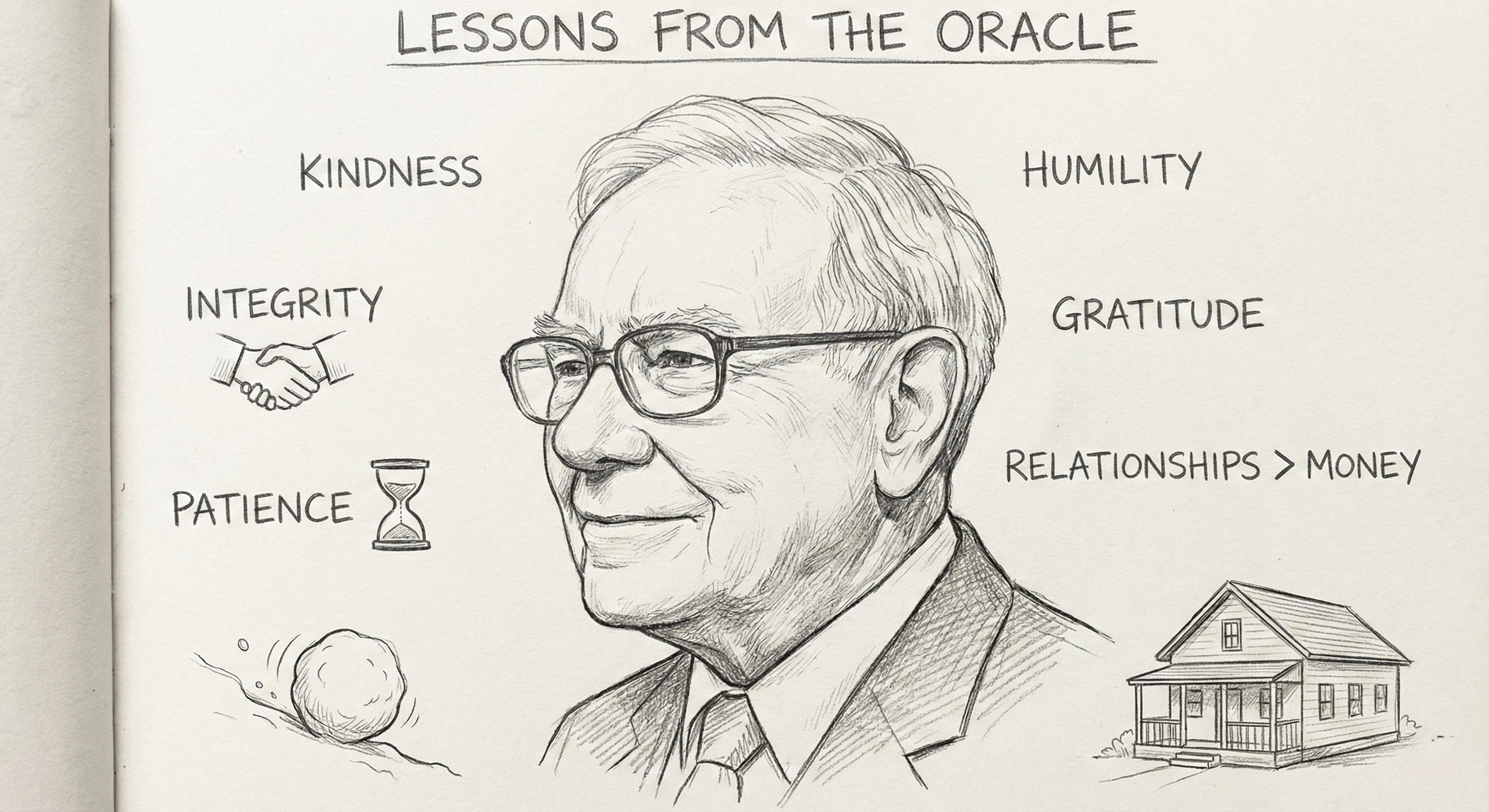
We spend so much time dissecting the Oracle of Omaha's portfolio. We analyse his 13F filings. We obsess over his cash pile. We scrutinise his every move in the Japanese markets, as well as his latest reduction in Apple shares. We treat him like a stock-picking algorithm made flesh.
But as Warren Buffett approaches his retirement at age 95, I have realised we have been paying attention to the wrong things.
I read a retrospective on his career recently that stopped me in my tracks. It was not about return on equity or economic moats. It was about character. It made me realise that Buffett is not just a great investor who happens to be a decent guy. He is a great investor because he is a decent guy. His philosophy on life and his philosophy on money are the exact same thing.
If you strip away the billions and the Berkshire Hathaway share price, you are left with a blueprint for a life well lived. Here is what we can learn from the legend that has absolutely nothing to do with money.
The Reputation Economy
We live in a world that moves fast. We want shortcuts. We want “growth hacks” and instant results. But Buffett plays a different game entirely. He understands that the most valuable currency you have is not the cash in your wallet. It is your reputation.
There is a quote of his that lives rent-free in my head: “It takes 20 years to build a reputation and five minutes to ruin it.”
Think about that. Five minutes.
Buffett built his empire on trust. When he bought businesses, he often did not strip them down or fire management. He treated the previous owners with dignity. There is a famous story about Rose Blumkin, who sold Nebraska Furniture Mart to him. She sold to him because he let her run the show her way. He treated her family with respect.
He calls this “kindness” in his letters, but I think it is actually a ruthless form of pragmatism. Kindness is efficient. Integrity cuts down on legal bills. When people trust you, deals get done faster. When people trust you, they bring you opportunities they would never show to a shark.
He once told Congress, regarding the Salomon Brothers scandal, that he would be understanding if employees lost money for the firm. But if they lost a shred of reputation? He would be ruthless.
In your own career, are you optimising for the quick win or the long game? Are you protecting your name as fiercely as you protect your bank account?
The Art of Standing Still
I feel like our collective attention span has shrunk to the length of a TikTok video. We feel the need to do something constantly. If we are not moving, we feel like we are falling behind.
Buffett teaches the opposite. He teaches the aggressive art of patience.
He famously said that the stock market is a device for transferring money from the impatient to the patient. But this applies to everything. It applies to your career. It applies to your relationships. It applies to learning a new skill.
Buffett views life like a snowball. The goal is to find wet snow and a really long hill. You need the “wet snow” (the right environment and opportunities) and the “long hill” (time).
We often underestimate the time component. We want the snowball to be huge now. But compounding takes time. It is boring. It requires you to sit on your hands and do nothing while everyone else is running around trying to look busy.
He once joked that he made most of his money “sitting on his ass.” There is a profound lesson for us there. Sometimes the bravest thing you can do is wait. Wait for the right pitch. Wait for the tide to turn. Just wait.
Mastering Your Own Mind
If you look at Berkshire Hathaway's history, you see a man completely immune to FOMO.
When the dot-com bubble was inflating in 1999, everyone called Buffett a dinosaur. They said he “didn’t get it.” He refused to buy tech stocks he did not understand. He looked foolish. Then the bubble burst, and he looked like a genius.
This is not just about being contrarian. It is about emotional stability. It is about independent thinking.
Buffett says, “You are neither right nor wrong because people agree with you. You are right because your facts and reasoning are right.”
How hard is it to live by that rule? We are social creatures. We want validation. We want to be part of the herd. To stand apart requires a deep sense of self-worth and a commitment to your own “circle of competence.”
Buffett knows what he knows, and more importantly, he knows what he does not know. He stays in his lane. He admits mistakes freely. He calls his errors “sins of omission” or “blunders.” There is zero ego in it. He knows that humility disarms people.
Imagine how much anxiety you could save yourself if you stopped trying to have an opinion on everything. Imagine the peace of admitting “I don’t know” and focusing only on the things you truly understand.
The Wealth That Actually Matters
Perhaps the most surprising thing about Buffett is his gratitude.
Here is a man who could buy small countries, yet he credits his success to the “Ovarian Lottery.” He admits he was lucky to be born in America in 1930 as a white male with a specific set of skills that the market happened to value.
He does not walk around acting like a conqueror. He walks around like a man who knows he has been incredibly fortunate.
This gratitude fuels a deep sense of contentment. He still lives in the same house he bought in 1958. He eats the same breakfast. He drinks Cherry Coke. He has zero interest in keeping up with the Joneses, mostly because he realised long ago that the Joneses are usually swimming naked when the tide goes out.
He has said that envy is the stupidest of the seven deadly sins because it is the only one you don’t have any fun doing.
So what is the metric? If it is not money, what is it?
Buffett gave us the answer. He told a group of students that the ultimate test of a life is simple: “The purpose of life is to be loved by as many people as possible among those you want to have love you.”
That is it. That is the scorecard.
The Final Verdict
As Buffett prepares to step down, we will see many retrospectives on his compounded annual returns. We will see charts showing how much you would have made if you had invested $1,000 in Berkshire in 1965.
But I want you to look past the math.
I want you to look at the man who showed us that you can be wildly successful without being a jerk. You can be wealthy without losing your soul. You can be powerful without losing your humility.
The lesson is not to buy Coca-Cola stock. The lesson is to be the kind of person who deserves to be loved. The lesson is to build a reputation that can survive a storm. The lesson is to be patient when the world is manic and kind when the world is cruel.
The ticker symbol for that kind of investment is not listed on the NYSE, but the returns are infinite.
#WarrenBuffett #LifeLessons #PersonalGrowth #Wisdom #Leadership
If you found value in this article, please hold down the like ❤️ button or consider buying me a coffee ☕️ to fuel the next one!