
Why “Hard Work” is the Wrong Hedge Against AI (And What to Do Instead)
You’re worried about the 2026 job market. You should be.

Welcome to The Long Game ♟️, a newsletter about GARP investing and money matters. The Long Game runs on disciplined analysis and fundamental metrics. If you’d like to support this, please subscribe.
The Long Game ♟️- Perspective An occasional macro view series:
The headlines are confusing. On one hand, you see reports of “acute labour shortages” in Japan and the West, with vacancies at 30-year highs. On the other hand, you see white-collar layoffs and AI displacing “knowledge workers” in droves.
Most people read this and think: “I need to work harder. I need to make myself (or my kids) more productive, more efficient, more standardised.”
That is the losing trade.
If you are playing The Long Game, you need to understand that we are in the middle of a valuation flip. The market is re-pricing human capital in real time. The asset class that generated wealth for the last 50 years, Standardised Efficiency, is crashing. The asset class of the next 50 years is Idiosyncratic Creativity.
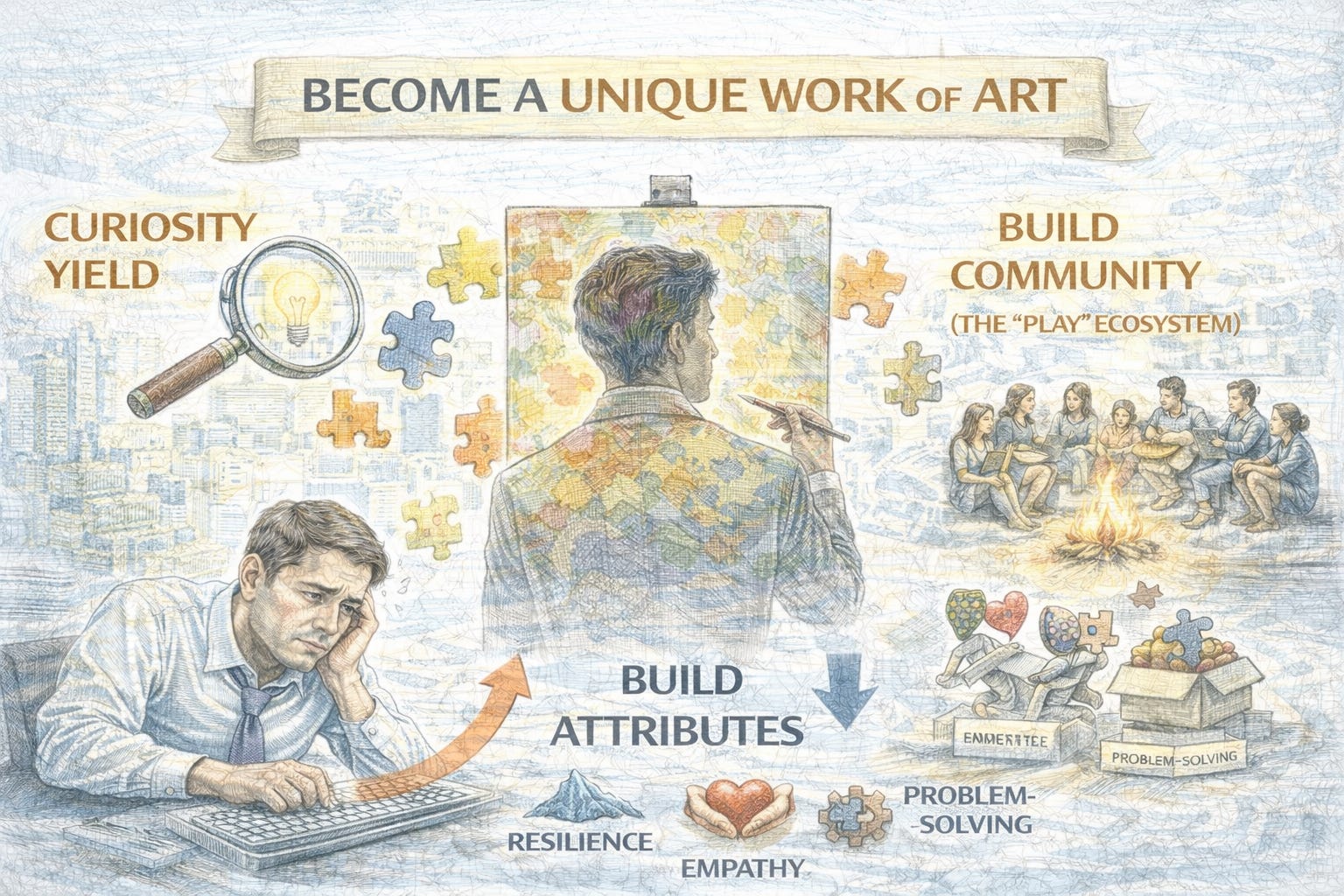
The “Grind” is dead, and why “Play” is your new R&D.
The “Action” Trap: Why You Can’t Out-Work Zero Marginal Cost
Japan is our crystal ball. They are running out of people. The demographic collapse there has created a “seller’s market” for talent. But here is the nuance most miss: Companies aren’t just grabbing anyone. They are fiercely competing for brains, not just hands.
For decades, success meant “Action All Night”, or working longer hours, processing more files, being a faster cog.
Today, “Action” is being demonetised.
If your value comes from doing things (processing data, writing standard code, organising schedules), you are competing with AI that has a marginal cost of zero. You cannot out-grind a system that doesn’t sleep.
The shift is from “Action” to “Insight.”
The Japanese economy didn’t survive its “Lost Decades” by working harder (that model broke in the 90s). It survived through players like Nintendo and Uniqlo. These are companies that didn’t sell “labour,” but sold experience, design, and emotional connection.
The New Alpha: “Play” as a Strategic Moat
If efficiency is a commodity, inefficiency is the luxury.
This sounds counterintuitive to a sophisticated investor, but bear with me. “Play” is essentially unbounded exploration. It is doing things not because they are “productive,” but because they are interesting.
Why is this a hedge?
Play creates “Deep” Value: AI is trained on the average of all human knowledge. It produces the median result instantly. To beat the median, you need to go deep into niches where no dataset exists. Only obsession (play) takes you there.
Play creates “Long” Durability: You cannot force yourself to do 10,000 hours of something you hate just to beat an algorithm. You can easily do 10,000 hours of something you love. “Play” is the only fuel source sustainable enough to reach mastery.
Play creates “True” Connection: The “Experience Economy” is booming because humans crave other humans. We don’t pay for “perfect” service anymore (bots do that); we pay for connection, empathy, and story. These are byproducts of genuine human enthusiasm, i.e., play.
The Portfolio Shift: From “Standard Product” to “Unique Art”
Stop treating your career (or your child’s education) like a factory line.
If you are trying to become a “Standardised Product” (a generic lawyer, a generic coder, a generic manager), you are positioning yourself in a Red Ocean that is shrinking.
Your strategy must be to become a “Unique Work of Art.”
Don’t optimise for “Resume Value.” Optimise for “Curiosity Yield.”
Don’t build “Skills.” Build “Attributes” like resilience, empathy, and the ability to solve unstructured problems.
Don’t “Network.” Build communities around shared passions (the “Play” ecosystem).
Final Thought
We are moving from an economy of Muscles and Efficiency to an economy of Nerves and Empathy.
If you are still forcing yourself to be a “better screw” in the machine, you are fighting the last war. The winners of 2026 and beyond won’t be the ones who followed the rules the best; they will be the ones who knew how to write their own game.
The Question:
If your current income relies entirely on “standardised action” rather than “creative insight,” is your career actually an asset, or is it a liability waiting to be written down?
If you found value in this article, please hold down the like ❤️ button or consider buying me a coffee ☕️ to fuel the next one!